08 May 2007

Another Baby, Another Blanket

I mentioned earlier that we had lunch on Sunday with my husband's college roommate and his wife. They have twin daughters, one of whom is just finishing her residency in surgery and is expecting her first child in November, much to their great delight. The other twin has three children, so our friends have gotten pretty good at being grandparents, but you know how it is, grandparents are always thrilled to have another grandbaby to spoil. Both of their daughters live in the Los Angeles area, so they see each other a lot, too.

As a knitter, I immediately jumped on this wonderful opportunity to knit something useful for the new baby. I haven't mentioned this to our friends yet, but I just bought the yarn from one of my favorite eBay sellers, Yarnbow, and it should arrive by the weekend. I picked Lorna's Laces Shepherd Sport, which is Superwash wool, in color 601, Rainbow.


Isn't that just great yarn for a baby blanket? The pale pastel "baby" colors really show the dirt quickly but this yarn won't. Babies are adorable but they can be kind of messy, so this is important. The yarn is machine washable, too. Blankets that can only be washed by hand are right up there with little outfits that have to be ironed for impracticality. New mothers have it hard enough without adding silliness like that.

The pattern I'm using is the Argosy Baby Blanket by Vyvyan Neel, a very talented designer and an exceedingly nice person. If you look at some of the other patterns in the Argosy series, you'll get an idea of how this blanket is going to look in this yarn. The pattern calls for six skeins of Blue Sky Cotton 100%, which has 150 yd per skein and a gauge of 4 stitches per inch on US 9 (5.5 mm) needles. I'm using eight skeins of sport weight yarn with 200 yd per skein and a gauge of 6 stitches per inch on US 4 (3.5 mm) needles. I think it'll work out just fine, if only because the pattern calls for increasing until half the yarn is used and then decreasing. My blanket may not be exactly the same size as the pattern calls for, 54" x 47", but it won't be a lot smaller.

This baby blanket may take precedence over the Argosy baby blanket I'm knitting from the Great Adirondack Superwash merino in Bahama Mama, even though this baby is due in November and the other baby is arriving in August. That's mostly because we'll probably be seeing our friends again in three or four weeks, so if I have it done by then I won't have to pack the blanket up and ship it. Another factor is that August isn't exactly the best time of year for using a wool blanket, particularly in the desert, meaning August is not exactly a hard deadline.

Aircraft I Have Loved, Part One Continued

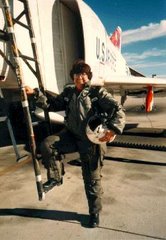
More about my favorite airplane, the F-4 Phantom II. The first F-4 I was ever up close and personal with was at NASA Dryden, back in the late '60s when I was a summer hire. We had an F-4 then. I don't know why or what it was used for and my copy of Hallion's book about the history of Dryden, like my copy the revised and updated version by Gorn and Hallion, is, for some inexplicable reason, at my house in Lancaster, not here in Palm Desert.

Anyway, one day this F-4 was out flying and the fuel pressure relief valve in one wing stopped working. Shortly thereafter the pressure of the fuel blew a hole right through the (wet) wing. Naturally, the pilot, Hugh Jackson, RTBd (Returned To Base) and landed right away. Some time later they brought the plane into the hangar and we all went down to see it. 'd never seen anything like it and probably wouldn't have believed that the fuel could generate enough pressure just from a little aerodynamic heating to blow a hole clear through the wing had I ever thought about it before it happened. It was quite amazing. Of course, we just repaired the wing and finished the program and somewhere along the line the airplane went away.

The next F-4 I was associated with was the analog fly-by-wire F-4 that McAir and the USAF were examining with an eye to reducing battle damage. I've written a bit about that one elsewhere and won't repeat it here.

At the same time, there was the F-4 that McAir was using for safety chase for the new F-15. This was an old F-4, bailed to McAir by the USAF years before and used for all sorts of experiments and programs, from testing new hardware to being safety chase. In its youth, it had been used to set some sort of speed record, in fact. With all those years as a testbed, it had picked up a lot of extra weight. When they'd install some bit of hardware it would have wiring and power supplies and other components, so when that particular test program was over they wouldn't go back and rip out everything they'd installed. Instead, they'd take out the pieces that were easy to reach, but they'd mostly just dyke the wiring off and leave it in place.

Carrying all this extra wire and other bits and pieces made the F-4 heavy and slow, so McAir decided to clear all that junk out. They sort of tore the airplane apart and pulled wire out like crazy. The crew accumulated all the wire and stuff they removed and, when they were done, built an awesome heap of it in the middle of the hangar. It was almost as high as the cockpit sill (11 ft) and proportionately large at the base. Of course, they crumpled the wire into balls, so the pile was pretty fluffy, but still that's a lot of wire and stuff. I was really impressed. The airplane was a lot faster, too.

Before I go on, I should mention that using an older airplane this way isn't at all uncommon. NASA Dryden, for example, only ever bought three new airplanes, the Lockheed F-104N Starfighters (which were actually F-104Gs without the weapons suites) to be support aircraft. All the rest were second-hand military aircraft. Even many of the research aircraft were hand-me-downs from the military, although the X-planes, for example, weren't.

Having said that, it won't be so surprising to read that the next F-4 I had something to do with belonged to AFFTC (the USAF Air Force Flight Test Center), having come there when the USAF exhibition team, the Thunderbirds, switched from F-4s to F-16s. That was back in the first energy crisis, in about 1973. This airplane, an F-4E, still had the oil smoker system from its days as a Thunderbird airplane installed, as well as an inverted oil system. It also had a controller box from its days as a cruise missile safety chase, when the engineer in the back seat was there in part to use that box to take control of the cruise missile and put it into a loiter mode until it ran out of fuel and fell out of the sky. The intent, of course, was that the falling out of the sky part should happen somewhere over the vast, extremely lightly populated desert, not over Lancaster or Santa Barbara.

How do I know so much about an AFFTC F-4? I got a ride in it is how. A good friend, whom I had helped when he was a student at the USAF Test Pilot School, had gotten tired of giving F-4 rides to TV actors (this was just after filming had ended for a made-for-TV movie about Pancho Barnes). He pitched giving me a ride to his CO by pointing out that I could actually recognize and identify an F-4 without help, just as I could identify all the other planes of the flightline, and that I had loved F-4s for decades, being well-known in some circles for my fondness for them. That flight was one of the highlights of my life. I wrote up a description at the time and I'll figure out how to get that posted, for anyone who is interested.

The last F-4 came to Dryden as the testbed for an experiment using spanwise blowing to control the flow over the wing. I believe it was part of the extensive laminar flow experimentation that our aerodynamics people were doing. The idea was to use engine bleed air blown down the wing (from root to tip) to attach the flow and reduce the boundary layer. At least, that's what I think it was, but I'm not an aerodynamicist and I could be wrong. Dryden got this F-4 from the USAF and started modifying it. However, further calculations ended up showing that there wasn't enough bleed air to work, even if they used all of it, which they couldn't. As a result, the experiment was abandoned, the airplane was put back the way it had been, and returned to the USAF. Not long after that, the USAF retired its F-4s completely. The AFFTC F-4Es were the last ones to go.

07 May 2007

A Four-Day Old Project On The Needles

This is my latest project, a feather and fan stole. It's knitted from a lovely hand-painted sock yarn according to my own pattern. I mean, it's pretty straightforward. There's a six-stitch-wide border (chain selvedge and five garter stitches) on each side and five repeats of an 18-stitch feather and fan, making it 102 stitches wide.


I started it with eight rows of garter stitch, which you can see, along with the feather and fan, in this photo. The colors are a little darker than this shows, with black, dark purple, and wine red.


I maybe should have knitted fewer garter-stitch rows, as these have a slight tendency to cup. By the time I figured that out I had about eight inches of stole knitted, so I decided I'd live with it. The digital knitter is a pragmatic knitter.

Here's something I find amusing, but then, I'm easily amused. I wound a great big skein of yarn into a big center-pull ball that was flat on top and bottom. As I've knitted away the ball has changed shape markedly. The bottom is still as flat as a pancake, but the top has gotten more and more domed. The ball is now a lot thicker than it came off the winder. I'm sure this growth from the friction when I pull yarn out as I knit.


I haven't gotten a lot knitted in the last few days. My husband's college roommate and his wife came over from Whittier to visit yesterday (Sunday). We hadn't seen them for a while, so it was a really nice long visit. I'd spent Thursday and Friday getting the last cartons either completely unpacked (sf books to live in Palm Desert, for example) or packed (knitting books to go back to Lancaster for the summer). Then Saturday we went to the supermarket and had a wonderful time shopping in the service deli and bakery. Four kinds of meat, five kinds of cheese, four kinds of rolls, salad, and a beautiful lemon and cream filling cake. Of course, I got the usual produce for sandwiches, too.

The deli salad was very interesting. I'd never had it before, but it looked so good I tried it. It's called fried corn salad and it has sweet corn, pozole, black beans, onions, sweet potato (I think), and green olives in a vinaigrette. Everyone really liked it. I had so much food on the table that I forgot the potato chips entirely, not remembering them until about six p.m.

We all had a wonderful time and they're probably going to come back in a couple of weeks. Considering that they live about a hundred miles away, it's not the shortest trip for them, but they said it was an easy drive, easier than fighting their way north to Lancaster.

As soon as I finish the stole, I've got to get started on a baby blanket. Here's the yarn, Great Adirondack superwash merino worsted weight in Bahama Mama. I'm going to use the Argosy pattern for it. It has to be done by August.


I was going to have the yarn for this custom-dyed, but I fell in love with the Bahama Mama colorway and decided to skip that step. I also got two skeins of Bahama Mama Chinchilla, for what I don't know. I just love the Great Adirondack colors and yarns.

My husband has been recording Knitty Gritty for me, using the DVR in our bedroom. I spent this afternoon watching a week's worth. I took my stole knitting, my new book on modular knitting, and my diet Coke and went back and camped on the bed to watch. I loved the skirt in butterfly stitch but didn't think much of the sushi toilet paper roll cover. I just adored Annie Modesitt's corset and intend to make one after the baby blanket.

The fourth show was on modular knitting, which I didn't know when I picked that book out, and the guest was Iris Schreier, author of Modular Knitting. That was the very book I'd been clutching to my bosom. I've decided I need Vivian Høxbro's Domino Knitting, too. One of the blogs I read has featured a sweater knitted in mitered squares and the techniques look very interesting to me.

03 May 2007

Catching Up On Photos

This is a collection of photos that I should have posted before. More will follow eventually, including one of the feather and fan stole I have on the needles.

I'll start with Forest Canopy Shawls. This is a close-up of the pattern knitted in Cherry Tree Hill 50/50 merino and silk DK in Dusk. I think it's knitted on US 8 needles. I think each leaf was about two inches long, but I didn't actually measure them.


And here's as much of the shawl as I knitted before I decided I was going to run out of yarn before it got as big as I wanted it to be. Isn't the yarn pretty? It's an absolute delight to work with. It has a lovely hand feel, it's not at all splitty, and it forms a very nice stitch.

You can see, if you look very closely at the corner, that it's .on a Knitpicks Options cable. Shortly after this photo was taken I frogged the shawl.

Here's a close-up photo of the Forest Canopy Shawl that I finished, just for comparison. It was knit with the same size needles, even though this yarn is fingering weight and the 50/50 is DK weight. I don't knit socks, but I love the hand-painted sock yarns that are so popular right now. They make beautiful lace.


I really like this pattern. It's pretty, it's not overly busy, and it's easy to memorize.

On to scarves. I love knitting scarves. They're useful, they're pretty, they don't take much yarn so splurging won't lead to bankruptcy, they can be complex enough to offer a real challenge, and they don't take forever to knit.

With all that said, here's the Argosy scarf I knitted for my brother-in-law in Iowa. The yarn is Lion Brand Cashmere Blend in Navy. The scarf took four skeins. This first photo shows it just off the needles. It has a lovely texture, as you can see.


Here it is after blocking. It's pretty flat and the pattern has really opened up. I didn't really stretch it, just pulled gently on the edges to make the corners nice and sharp. (Yes, I know the silver needs to be polished and I'm going to do that this weekend.)


And here's another photo to give you an idea of its size. It's about 9 in. wide and 8 ft long. Maybe you can get an impression of its hand, too. This yarn knits up into a lovely fabric. It's soft and cushy and very light.


Incidentally, this is in my dining room. It was late afternoon when I took these photos and this was the best natural light I could find. The wood is black and the chairs are covered with wisteria (pale purple mauve) Ultrasuede. The chairs are lighter than the grey couch and chair in the living room, but not a lot. The carpet is berry colored.

And here's the Morehouse Farms bulky merino scarf that I knitted for my sister-in-law. This first photo is a bit of a close-up so you can see the stitch (garter with drops) and the color.


And here's the whole thing. It's about 7 in. wide and 7 ft long.


This is another yarn that's a joy to work with. I just love it. Beautiful colors of wonderfully soft yarn that just about knits itself. The patterns they recommend are very simple, designed to show off the yarn.

02 May 2007

Camera To Laptop Problem Solved

Did you notice how nonchalantly I dropped those two photos of the pink top into my last posting? No whining about how much trouble I was having, just a couple of photos to illustrate what I was writing about.

Well, I have to admit, right here in front of God and everyone, that it was all my fault that I couldn't post photos. Mostly. I was trying to use a USB cable and upload from my camera into my laptop (which I still can't do), when all that time I could have been taking the memory card out of the camera and plugging it right into my laptop. My laptop, which is pushing five years old, is limited on what kinds of memory cards it can read and I was just certain it couldn't read the card I use.

Wrong, wrong, wrongitty, wrong. My clever husband had made sure that my laptop could read the memory card when he bought me the camera. So all that complaining and all those photo-less postings were totally unnecessary.

I'll now go back and check the postings to see what I should post photos of. I don't think it's a lot, though. I'd thought of sneaking back and editing the postings to add the photos, but figured out that no one who had read them originally would read them again, which made that a really stupid idea.