Edited, with my sincere apologies to Pennsylvanians, to correct the name of Harrisburg.
My microwave has gone from Harrisburg, PA, to Louisville, KY. I hope it's getting on a big brown airplane bound for Southern California. gother package itineraries are representative, it'll get to Ontario Airport[1] at around 0300 and be in Lancaster by 0600, so it can be out for delivery by 0800. It should be at my house at about 1430.
It will be welcomed with open arms. I've had to actually cook dinner, rather than reheat a frozen meal, three nights in a row and I'm running out of ideas (and food) unless I go to the grocery store.
[1] This Ontario Airport isn't in Canada but in SoCal. It's one of five airports in the LA Basin with scheduled airline service (Los Angeles International, Burbank, Long Beach, Ontario, & John Wayne).[2] Ontario gets a lot of air freight business because it's got less air traffic and it's in a good location for trucking stuff around. The other airports in the Basin are really busy (LAX) or have shorter runways (Burbank) or are in noise-sensitive areas (John Wayne).[3]
[2] OK, Palmdale Airport has scheduled service, too, but it uses the USAF Plant 42 runways and stuff and isn't really an independent airport and it's not in the Basin, although it is in Los Angeles County. Van Nuys Airport doesn't have scheduled airline service, being a general aviation airport, but is still one of the busiest airports in the US. UPS could use it, I'm sure, but it's in a noise-sensitive area.
[3] Why people buy a house near an airport and then complain about the noise is something I do not understand. If you don't like airport noise, don't buy a house by an airport! You don't hear me complaining about Plant 42 or Fox Field or Bermuda Dunes Airport. Which reminds me of a funny story (a lot of things remind me of funny stories, probably because I'm easily amused). For background, you have to remember that Edwards Air Force Base is the USAF's flight testing base and does most of its flying between 0700 and 1600 on weekdays, unlike the regular Air Combat Command bases.
So, here's the story, from back in the days when realtors didn't have to warn prospective buyers about everything. Some family, who lived Down Below (that's what we call the Los Angeles Basin up here), came to Lancaster house-hunting on the weekends. They were looking for a little acreage and settled on a place out in the northwest corner of the valley. They moved up on a Saturday, got all settled in on Sunday, and were sleeping the sleep of the just on Monday morning when the first wave of USAF sorties launched at 0700 and a couple of the airplanes made runs down the Alpha Corridor into the bombing range at low altitude and high speed. The version I've heard says that the couple just about levitated out of bed, thinking they were under attack or something, because they hadn't heard or seen any military aircraft on the weekends and didn't realize how close the base really was.
This would have been a better story a decade or two later, when NASA started landing Orbiters at Edwards. Those come in from space dragging a spectacularly loud sonic boom that would have really jolted the folks out of bed.
Showing posts with label AFFTC. Show all posts
Showing posts with label AFFTC. Show all posts
21 June 2007


08 May 2007
Aircraft I Have Loved, Part One Continued
More about my favorite airplane, the F-4 Phantom II. The first F-4 I was ever up close and personal with was at NASA Dryden, back in the late '60s when I was a summer hire. We had an F-4 then. I don't know why or what it was used for and my copy of Hallion's book about the history of Dryden, like my copy the revised and updated version by Gorn and Hallion, is, for some inexplicable reason, at my house in Lancaster, not here in Palm Desert.
Anyway, one day this F-4 was out flying and the fuel pressure relief valve in one wing stopped working. Shortly thereafter the pressure of the fuel blew a hole right through the (wet) wing. Naturally, the pilot, Hugh Jackson, RTBd (Returned To Base) and landed right away. Some time later they brought the plane into the hangar and we all went down to see it. 'd never seen anything like it and probably wouldn't have believed that the fuel could generate enough pressure just from a little aerodynamic heating to blow a hole clear through the wing had I ever thought about it before it happened. It was quite amazing. Of course, we just repaired the wing and finished the program and somewhere along the line the airplane went away.
The next F-4 I was associated with was the analog fly-by-wire F-4 that McAir and the USAF were examining with an eye to reducing battle damage. I've written a bit about that one elsewhere and won't repeat it here.
At the same time, there was the F-4 that McAir was using for safety chase for the new F-15. This was an old F-4, bailed to McAir by the USAF years before and used for all sorts of experiments and programs, from testing new hardware to being safety chase. In its youth, it had been used to set some sort of speed record, in fact. With all those years as a testbed, it had picked up a lot of extra weight. When they'd install some bit of hardware it would have wiring and power supplies and other components, so when that particular test program was over they wouldn't go back and rip out everything they'd installed. Instead, they'd take out the pieces that were easy to reach, but they'd mostly just dyke the wiring off and leave it in place.
Carrying all this extra wire and other bits and pieces made the F-4 heavy and slow, so McAir decided to clear all that junk out. They sort of tore the airplane apart and pulled wire out like crazy. The crew accumulated all the wire and stuff they removed and, when they were done, built an awesome heap of it in the middle of the hangar. It was almost as high as the cockpit sill (11 ft) and proportionately large at the base. Of course, they crumpled the wire into balls, so the pile was pretty fluffy, but still that's a lot of wire and stuff. I was really impressed. The airplane was a lot faster, too.
Before I go on, I should mention that using an older airplane this way isn't at all uncommon. NASA Dryden, for example, only ever bought three new airplanes, the Lockheed F-104N Starfighters (which were actually F-104Gs without the weapons suites) to be support aircraft. All the rest were second-hand military aircraft. Even many of the research aircraft were hand-me-downs from the military, although the X-planes, for example, weren't.
Having said that, it won't be so surprising to read that the next F-4 I had something to do with belonged to AFFTC (the USAF Air Force Flight Test Center), having come there when the USAF exhibition team, the Thunderbirds, switched from F-4s to F-16s. That was back in the first energy crisis, in about 1973. This airplane, an F-4E, still had the oil smoker system from its days as a Thunderbird airplane installed, as well as an inverted oil system. It also had a controller box from its days as a cruise missile safety chase, when the engineer in the back seat was there in part to use that box to take control of the cruise missile and put it into a loiter mode until it ran out of fuel and fell out of the sky. The intent, of course, was that the falling out of the sky part should happen somewhere over the vast, extremely lightly populated desert, not over Lancaster or Santa Barbara.
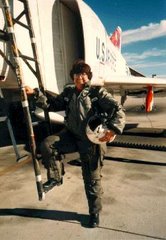
How do I know so much about an AFFTC F-4? I got a ride in it is how. A good friend, whom I had helped when he was a student at the USAF Test Pilot School, had gotten tired of giving F-4 rides to TV actors (this was just after filming had ended for a made-for-TV movie about Pancho Barnes). He pitched giving me a ride to his CO by pointing out that I could actually recognize and identify an F-4 without help, just as I could identify all the other planes of the flightline, and that I had loved F-4s for decades, being well-known in some circles for my fondness for them. That flight was one of the highlights of my life. I wrote up a description at the time and I'll figure out how to get that posted, for anyone who is interested.
The last F-4 came to Dryden as the testbed for an experiment using spanwise blowing to control the flow over the wing. I believe it was part of the extensive laminar flow experimentation that our aerodynamics people were doing. The idea was to use engine bleed air blown down the wing (from root to tip) to attach the flow and reduce the boundary layer. At least, that's what I think it was, but I'm not an aerodynamicist and I could be wrong. Dryden got this F-4 from the USAF and started modifying it. However, further calculations ended up showing that there wasn't enough bleed air to work, even if they used all of it, which they couldn't. As a result, the experiment was abandoned, the airplane was put back the way it had been, and returned to the USAF. Not long after that, the USAF retired its F-4s completely. The AFFTC F-4Es were the last ones to go.
Anyway, one day this F-4 was out flying and the fuel pressure relief valve in one wing stopped working. Shortly thereafter the pressure of the fuel blew a hole right through the (wet) wing. Naturally, the pilot, Hugh Jackson, RTBd (Returned To Base) and landed right away. Some time later they brought the plane into the hangar and we all went down to see it. 'd never seen anything like it and probably wouldn't have believed that the fuel could generate enough pressure just from a little aerodynamic heating to blow a hole clear through the wing had I ever thought about it before it happened. It was quite amazing. Of course, we just repaired the wing and finished the program and somewhere along the line the airplane went away.
The next F-4 I was associated with was the analog fly-by-wire F-4 that McAir and the USAF were examining with an eye to reducing battle damage. I've written a bit about that one elsewhere and won't repeat it here.
At the same time, there was the F-4 that McAir was using for safety chase for the new F-15. This was an old F-4, bailed to McAir by the USAF years before and used for all sorts of experiments and programs, from testing new hardware to being safety chase. In its youth, it had been used to set some sort of speed record, in fact. With all those years as a testbed, it had picked up a lot of extra weight. When they'd install some bit of hardware it would have wiring and power supplies and other components, so when that particular test program was over they wouldn't go back and rip out everything they'd installed. Instead, they'd take out the pieces that were easy to reach, but they'd mostly just dyke the wiring off and leave it in place.
Carrying all this extra wire and other bits and pieces made the F-4 heavy and slow, so McAir decided to clear all that junk out. They sort of tore the airplane apart and pulled wire out like crazy. The crew accumulated all the wire and stuff they removed and, when they were done, built an awesome heap of it in the middle of the hangar. It was almost as high as the cockpit sill (11 ft) and proportionately large at the base. Of course, they crumpled the wire into balls, so the pile was pretty fluffy, but still that's a lot of wire and stuff. I was really impressed. The airplane was a lot faster, too.
Before I go on, I should mention that using an older airplane this way isn't at all uncommon. NASA Dryden, for example, only ever bought three new airplanes, the Lockheed F-104N Starfighters (which were actually F-104Gs without the weapons suites) to be support aircraft. All the rest were second-hand military aircraft. Even many of the research aircraft were hand-me-downs from the military, although the X-planes, for example, weren't.
Having said that, it won't be so surprising to read that the next F-4 I had something to do with belonged to AFFTC (the USAF Air Force Flight Test Center), having come there when the USAF exhibition team, the Thunderbirds, switched from F-4s to F-16s. That was back in the first energy crisis, in about 1973. This airplane, an F-4E, still had the oil smoker system from its days as a Thunderbird airplane installed, as well as an inverted oil system. It also had a controller box from its days as a cruise missile safety chase, when the engineer in the back seat was there in part to use that box to take control of the cruise missile and put it into a loiter mode until it ran out of fuel and fell out of the sky. The intent, of course, was that the falling out of the sky part should happen somewhere over the vast, extremely lightly populated desert, not over Lancaster or Santa Barbara.
How do I know so much about an AFFTC F-4? I got a ride in it is how. A good friend, whom I had helped when he was a student at the USAF Test Pilot School, had gotten tired of giving F-4 rides to TV actors (this was just after filming had ended for a made-for-TV movie about Pancho Barnes). He pitched giving me a ride to his CO by pointing out that I could actually recognize and identify an F-4 without help, just as I could identify all the other planes of the flightline, and that I had loved F-4s for decades, being well-known in some circles for my fondness for them. That flight was one of the highlights of my life. I wrote up a description at the time and I'll figure out how to get that posted, for anyone who is interested.
The last F-4 came to Dryden as the testbed for an experiment using spanwise blowing to control the flow over the wing. I believe it was part of the extensive laminar flow experimentation that our aerodynamics people were doing. The idea was to use engine bleed air blown down the wing (from root to tip) to attach the flow and reduce the boundary layer. At least, that's what I think it was, but I'm not an aerodynamicist and I could be wrong. Dryden got this F-4 from the USAF and started modifying it. However, further calculations ended up showing that there wasn't enough bleed air to work, even if they used all of it, which they couldn't. As a result, the experiment was abandoned, the airplane was put back the way it had been, and returned to the USAF. Not long after that, the USAF retired its F-4s completely. The AFFTC F-4Es were the last ones to go.
04 April 2007
Oops! Oops, Almost! And A Bit About My Early Career
I finished the Morehouse Farm FishKnit scarf yesterday. It's just gorgeous and the yarn is an absolute wonder. One tiny flaw, though, which I discovered after I was done. They sent me the wrong color. I'd ordered "Zest" and they sent the berry-colored yarn. Oops! Obviously, I didn't have much of an investment in the color, since I didn't even notice until I'd finished knitting the scarf, but I did call them to give them a chance to set their inventory system right.
The second Oops wasn't, fortunately. I was opening more cartons that we'd brought down from Lancaster and discovered what I thought at first was another box of knitting books. Now I was quite sure I'd only brought two boxes of these, so discovering another was kind of a shock. When I pulled out the two knitting books on the top I found mystery and scifi magazines nestled atop the phone and headset my husband had bought. What a relief. There's a limit to how much shelf space I have and another box of books would have thrown me into total disarray.
Our friend and former cow-orker who flew the SR-71 was by on the weekend. He didn't have much news about NASA but did remark that he enjoyed seeing the research aircraft he'd flown on display, particularly the Blackbird. I didn't have the heart to ask him if the F-8 Digital Fly-By-Wire was one of his favorites; it's a squatty little USN plane of no particular grace, although it had great merit. I liked it myself, but not for its looks. I spent a fair chunk of my career working on it.
The first airplane I worked on, where I had my own particular aircraft that I could go down to the hangar and look at, was an F-4 Phantom II. I was working for McDonnell Aircraft Co. at Edwards AFB, waiting for the new, unflown F-15 Eagle to show up. In the meantime, I worked on this F-4, which had an analog fly-by-wire system installed. This was being evaluated for resistance to battle damage, hence the project name SFCS, Survivable Flight Conditions Systems. Some really badly damaged F-4 had managed to struggle home in Vietnam and the USAF and McAir were trying to increase the percentage that made it back. This was in '72, when the fighting was still going on in Southeast Asia.
When the F-15 finally arrived (it did fly in, but in the back of a USAF transport aircraft, with its wings not installed) I worked on both F-15 #1 and the F-4 SFCS. About the time the second F-15 arrived, the F-4 program ended and I worked exclusively on F-15s. I eventually had three aircraft, numbers 1, 2, and 7 (I think) of my own.
I was a data engineer, handling the data processing requirements of the various discipline engineers. This was shortly after I'd finished the course work for my MS in Engineering from UCLA and had worked at NASA Dryden on stability and control derivative estimation. I was doling out the overnight computer results (the computer was in St Louis and we did everything remotely) and really startled and amazed an engineer by sorting out some of his maneuvers and pointing out that he'd gotten the start times about a second too late and needed to re-run them. He was astounded that I knew that much, since my position was an entry-level sort of job, with no real expertise required. Once they realized I was married to the guy who invented the estimation technique and had some experience in the analysis, my job changed a bit. They also started trying to recruit my husband away from NASA, telling us we'd love St Louis, etc.
Anyway, I misjudged the length of the F-15 Cat I & II testing and went to work for the General Services Administration down at the USAF AFFTC (Air Force Flight Test Center) as a Brooks Bill computer programmer (the Bill allowed agencies to hire contractors to help convert old programs, etc, when the agencies got new computers). I'd thought the McAir job only had a couple of years more to run, but I was really wrong. Still, I got a permanent Civil Service appointment with GSA, which counted for a lot.
About a year later, in the middle of a hiring freeze, Dryden had a engineering position open up. It was for a GS-9 engineer, no relocation expenses, and they opened it, by law, first to NASA employees who had been RIF'd or RIG'd (Reduction In Force, Reduction In Grade). Being a lowish grade, with no moving expenses, they didn't get any takers. Then they posted it again, for current NASA and other agency employees, because they couldn't hire anyone, just transfer people either within NASA or from other agencies. I was the only eligible applicant and they didn't have to ask me twice if I wanted the job. Finally! Not quite 28 years later I finally left.
The second Oops wasn't, fortunately. I was opening more cartons that we'd brought down from Lancaster and discovered what I thought at first was another box of knitting books. Now I was quite sure I'd only brought two boxes of these, so discovering another was kind of a shock. When I pulled out the two knitting books on the top I found mystery and scifi magazines nestled atop the phone and headset my husband had bought. What a relief. There's a limit to how much shelf space I have and another box of books would have thrown me into total disarray.
Our friend and former cow-orker who flew the SR-71 was by on the weekend. He didn't have much news about NASA but did remark that he enjoyed seeing the research aircraft he'd flown on display, particularly the Blackbird. I didn't have the heart to ask him if the F-8 Digital Fly-By-Wire was one of his favorites; it's a squatty little USN plane of no particular grace, although it had great merit. I liked it myself, but not for its looks. I spent a fair chunk of my career working on it.
The first airplane I worked on, where I had my own particular aircraft that I could go down to the hangar and look at, was an F-4 Phantom II. I was working for McDonnell Aircraft Co. at Edwards AFB, waiting for the new, unflown F-15 Eagle to show up. In the meantime, I worked on this F-4, which had an analog fly-by-wire system installed. This was being evaluated for resistance to battle damage, hence the project name SFCS, Survivable Flight Conditions Systems. Some really badly damaged F-4 had managed to struggle home in Vietnam and the USAF and McAir were trying to increase the percentage that made it back. This was in '72, when the fighting was still going on in Southeast Asia.
When the F-15 finally arrived (it did fly in, but in the back of a USAF transport aircraft, with its wings not installed) I worked on both F-15 #1 and the F-4 SFCS. About the time the second F-15 arrived, the F-4 program ended and I worked exclusively on F-15s. I eventually had three aircraft, numbers 1, 2, and 7 (I think) of my own.
I was a data engineer, handling the data processing requirements of the various discipline engineers. This was shortly after I'd finished the course work for my MS in Engineering from UCLA and had worked at NASA Dryden on stability and control derivative estimation. I was doling out the overnight computer results (the computer was in St Louis and we did everything remotely) and really startled and amazed an engineer by sorting out some of his maneuvers and pointing out that he'd gotten the start times about a second too late and needed to re-run them. He was astounded that I knew that much, since my position was an entry-level sort of job, with no real expertise required. Once they realized I was married to the guy who invented the estimation technique and had some experience in the analysis, my job changed a bit. They also started trying to recruit my husband away from NASA, telling us we'd love St Louis, etc.
Anyway, I misjudged the length of the F-15 Cat I & II testing and went to work for the General Services Administration down at the USAF AFFTC (Air Force Flight Test Center) as a Brooks Bill computer programmer (the Bill allowed agencies to hire contractors to help convert old programs, etc, when the agencies got new computers). I'd thought the McAir job only had a couple of years more to run, but I was really wrong. Still, I got a permanent Civil Service appointment with GSA, which counted for a lot.
About a year later, in the middle of a hiring freeze, Dryden had a engineering position open up. It was for a GS-9 engineer, no relocation expenses, and they opened it, by law, first to NASA employees who had been RIF'd or RIG'd (Reduction In Force, Reduction In Grade). Being a lowish grade, with no moving expenses, they didn't get any takers. Then they posted it again, for current NASA and other agency employees, because they couldn't hire anyone, just transfer people either within NASA or from other agencies. I was the only eligible applicant and they didn't have to ask me twice if I wanted the job. Finally! Not quite 28 years later I finally left.
Subscribe to:
Posts (Atom)