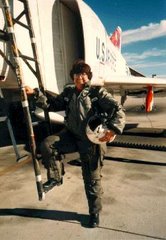
It's funny about airplanes; we love them for the oddest reasons. Sometimes it's because they're just plain beautiful, sometimes it's because they're not. I don't just have one favorite, I've got a bunch. Favorite century-series fighter, favorite post-century-series fighter, favorite transport, favorite bomber, favorite recce plane, favorite lifting body, favorite carrier airplane, favorite Soviet airplane, favorite Antipodean airplane, favorite attack airplane, favorite X-plane, and so on.
My favorite "regular" post-century-series fighter airplane is the McAir F-4 Phantom II, with the McAir F-15 Eagle running it a close second. Both of these airplanes are definitely heavy metal. The F-4[1] is extremely resistant to battle damage and so, probably, is the F-15 (it just hasn't been in as much combat). There were F-4s in Vietnam that came home sucking fuel from a tanker because they'd been so shot up that their tanks couldn't hold enough fuel to keep the engines running. And there was an Israeli F-15 that lost almost all of one wing in a mid-air collision and still flew and landed safely. In fact, they replaced the wing and the airplane went back into regular use.
The F-4 has been called "the triumph of thrust over aerodynamics", among other things, and there's a kernel of truth in this description. It's excess thrust that made the F-4 such a successful airplane and such a favorite with pilots. It was possible to put a tremendous load on the F-4 and still fly reasonable distances. It could be decked with all sorts of munitions and have enough thrust to take off and fly with them. It was big and tough and, to quote one of my friends who flew them, "a real man's airplane". It looked like a kick-ass war plane.
I love F-4s. Getting a ride in one was one of the highlights of my life. I was lucky.
I still remember what must have been the last time I saw F-4s take off. We'd gone to Reno in mid-January to go to the AIAA Aerospace Sciences Conference because I was on the Atmospheric Flight Mechanics Technical Committee and we had a meeting every year at Aerospace Sciences. I was walking out to pick up the rental car and go back for my husband and the luggage and I heard the magic sound of four J79 engines spooling up. I looked over at the runway and there were two Nevada Air National Guard F-4s doing the last before-takeoff checks. They finished the checklist and, after a moment poised there in (probably) MIL power, they released the brakes and started rolling down the runway. Going faster and faster they rotated and lifted off gracefully, in a perfect formation takeoff, and flew away into the blue winter sky. It was just beautiful.
[1] This way of referring to an airplane, with the letter and number, is my habit because that's how we do it at NASA Dryden. We don't call airplanes by their names or, usually, by their nicknames. It's an F-4, not a Phantom or an Iron Rhino or Double Ugly or Old Smoky.
Showing posts with label F-15. Show all posts
Showing posts with label F-15. Show all posts
28 April 2007


04 April 2007
Oops! Oops, Almost! And A Bit About My Early Career
I finished the Morehouse Farm FishKnit scarf yesterday. It's just gorgeous and the yarn is an absolute wonder. One tiny flaw, though, which I discovered after I was done. They sent me the wrong color. I'd ordered "Zest" and they sent the berry-colored yarn. Oops! Obviously, I didn't have much of an investment in the color, since I didn't even notice until I'd finished knitting the scarf, but I did call them to give them a chance to set their inventory system right.
The second Oops wasn't, fortunately. I was opening more cartons that we'd brought down from Lancaster and discovered what I thought at first was another box of knitting books. Now I was quite sure I'd only brought two boxes of these, so discovering another was kind of a shock. When I pulled out the two knitting books on the top I found mystery and scifi magazines nestled atop the phone and headset my husband had bought. What a relief. There's a limit to how much shelf space I have and another box of books would have thrown me into total disarray.
Our friend and former cow-orker who flew the SR-71 was by on the weekend. He didn't have much news about NASA but did remark that he enjoyed seeing the research aircraft he'd flown on display, particularly the Blackbird. I didn't have the heart to ask him if the F-8 Digital Fly-By-Wire was one of his favorites; it's a squatty little USN plane of no particular grace, although it had great merit. I liked it myself, but not for its looks. I spent a fair chunk of my career working on it.
The first airplane I worked on, where I had my own particular aircraft that I could go down to the hangar and look at, was an F-4 Phantom II. I was working for McDonnell Aircraft Co. at Edwards AFB, waiting for the new, unflown F-15 Eagle to show up. In the meantime, I worked on this F-4, which had an analog fly-by-wire system installed. This was being evaluated for resistance to battle damage, hence the project name SFCS, Survivable Flight Conditions Systems. Some really badly damaged F-4 had managed to struggle home in Vietnam and the USAF and McAir were trying to increase the percentage that made it back. This was in '72, when the fighting was still going on in Southeast Asia.
When the F-15 finally arrived (it did fly in, but in the back of a USAF transport aircraft, with its wings not installed) I worked on both F-15 #1 and the F-4 SFCS. About the time the second F-15 arrived, the F-4 program ended and I worked exclusively on F-15s. I eventually had three aircraft, numbers 1, 2, and 7 (I think) of my own.
I was a data engineer, handling the data processing requirements of the various discipline engineers. This was shortly after I'd finished the course work for my MS in Engineering from UCLA and had worked at NASA Dryden on stability and control derivative estimation. I was doling out the overnight computer results (the computer was in St Louis and we did everything remotely) and really startled and amazed an engineer by sorting out some of his maneuvers and pointing out that he'd gotten the start times about a second too late and needed to re-run them. He was astounded that I knew that much, since my position was an entry-level sort of job, with no real expertise required. Once they realized I was married to the guy who invented the estimation technique and had some experience in the analysis, my job changed a bit. They also started trying to recruit my husband away from NASA, telling us we'd love St Louis, etc.
Anyway, I misjudged the length of the F-15 Cat I & II testing and went to work for the General Services Administration down at the USAF AFFTC (Air Force Flight Test Center) as a Brooks Bill computer programmer (the Bill allowed agencies to hire contractors to help convert old programs, etc, when the agencies got new computers). I'd thought the McAir job only had a couple of years more to run, but I was really wrong. Still, I got a permanent Civil Service appointment with GSA, which counted for a lot.
About a year later, in the middle of a hiring freeze, Dryden had a engineering position open up. It was for a GS-9 engineer, no relocation expenses, and they opened it, by law, first to NASA employees who had been RIF'd or RIG'd (Reduction In Force, Reduction In Grade). Being a lowish grade, with no moving expenses, they didn't get any takers. Then they posted it again, for current NASA and other agency employees, because they couldn't hire anyone, just transfer people either within NASA or from other agencies. I was the only eligible applicant and they didn't have to ask me twice if I wanted the job. Finally! Not quite 28 years later I finally left.
The second Oops wasn't, fortunately. I was opening more cartons that we'd brought down from Lancaster and discovered what I thought at first was another box of knitting books. Now I was quite sure I'd only brought two boxes of these, so discovering another was kind of a shock. When I pulled out the two knitting books on the top I found mystery and scifi magazines nestled atop the phone and headset my husband had bought. What a relief. There's a limit to how much shelf space I have and another box of books would have thrown me into total disarray.
Our friend and former cow-orker who flew the SR-71 was by on the weekend. He didn't have much news about NASA but did remark that he enjoyed seeing the research aircraft he'd flown on display, particularly the Blackbird. I didn't have the heart to ask him if the F-8 Digital Fly-By-Wire was one of his favorites; it's a squatty little USN plane of no particular grace, although it had great merit. I liked it myself, but not for its looks. I spent a fair chunk of my career working on it.
The first airplane I worked on, where I had my own particular aircraft that I could go down to the hangar and look at, was an F-4 Phantom II. I was working for McDonnell Aircraft Co. at Edwards AFB, waiting for the new, unflown F-15 Eagle to show up. In the meantime, I worked on this F-4, which had an analog fly-by-wire system installed. This was being evaluated for resistance to battle damage, hence the project name SFCS, Survivable Flight Conditions Systems. Some really badly damaged F-4 had managed to struggle home in Vietnam and the USAF and McAir were trying to increase the percentage that made it back. This was in '72, when the fighting was still going on in Southeast Asia.
When the F-15 finally arrived (it did fly in, but in the back of a USAF transport aircraft, with its wings not installed) I worked on both F-15 #1 and the F-4 SFCS. About the time the second F-15 arrived, the F-4 program ended and I worked exclusively on F-15s. I eventually had three aircraft, numbers 1, 2, and 7 (I think) of my own.
I was a data engineer, handling the data processing requirements of the various discipline engineers. This was shortly after I'd finished the course work for my MS in Engineering from UCLA and had worked at NASA Dryden on stability and control derivative estimation. I was doling out the overnight computer results (the computer was in St Louis and we did everything remotely) and really startled and amazed an engineer by sorting out some of his maneuvers and pointing out that he'd gotten the start times about a second too late and needed to re-run them. He was astounded that I knew that much, since my position was an entry-level sort of job, with no real expertise required. Once they realized I was married to the guy who invented the estimation technique and had some experience in the analysis, my job changed a bit. They also started trying to recruit my husband away from NASA, telling us we'd love St Louis, etc.
Anyway, I misjudged the length of the F-15 Cat I & II testing and went to work for the General Services Administration down at the USAF AFFTC (Air Force Flight Test Center) as a Brooks Bill computer programmer (the Bill allowed agencies to hire contractors to help convert old programs, etc, when the agencies got new computers). I'd thought the McAir job only had a couple of years more to run, but I was really wrong. Still, I got a permanent Civil Service appointment with GSA, which counted for a lot.
About a year later, in the middle of a hiring freeze, Dryden had a engineering position open up. It was for a GS-9 engineer, no relocation expenses, and they opened it, by law, first to NASA employees who had been RIF'd or RIG'd (Reduction In Force, Reduction In Grade). Being a lowish grade, with no moving expenses, they didn't get any takers. Then they posted it again, for current NASA and other agency employees, because they couldn't hire anyone, just transfer people either within NASA or from other agencies. I was the only eligible applicant and they didn't have to ask me twice if I wanted the job. Finally! Not quite 28 years later I finally left.
Subscribe to:
Posts (Atom)